


Xiaohongshu, often dubbed “China’s Instagram-meets-Pinterest,” is making another attempt at going global. Launching in June, its new platform Redshop will debut with an exclusive group of 50 merchants focusing on handcrafted cultural goods. The target markets include the U.S., UK, and Australia.
This shift comes after a year of international challenges. In early 2025, Xiaohongshu briefly went viral in the U.S., capitalizing on backlash from TikTok’s legal battles. For one week, its app Rednot soared to the top of U.S. charts, chalking up 3.84 million downloads. Yet the spotlight didn’t last, and Xiaohongshu’s cross-border e-commerce plan has taken a year to materialize.
Why bet on cultural exports now? The answer lies in differentiation. Redshop avoids competing head-on with Temu or SHEIN, whose price-volume strategies dominate global markets, instead spotlighting unique cultural products. But with previous international forays falling short, Redshop’s restrained launch poses a lingering question: is this cautious approach too little, too late?
What is Redshop
According to industry insiders, Xiaohongshu is going all in on its new cross-border e-commerce venture, Redshop. In February, the company set up a separate international team, led by a seasoned e-commerce veteran known internally as “Silver Time.” Responsible for spearheading key domestic efforts like livestreaming and operations between 2023 and 2025, his leadership signals that Redshop is more than an experiment.
Redshop mirrors a framework Xiaohongshu tested in March 2025 during a small-scale pilot, where merchants shipped goods to designated warehouses, leaving customs, international logistics, and final delivery to the platform. However, past trial participants reported significant issues, including rushed timelines, unclear policies, and underdeveloped logistic support, which initially seemed like a reactionary move to absorb TikTok’s displaced traffic.
As of April 15, the official Redshop account has been recruiting key personnel such as product managers, category specialists, and even full-stack AI engineers.
Strategically, Xiaohongshu aims to sidestep head-on competition with global leaders like SHEIN and Temu by avoiding scale-driven strategies and focusing on carving out its own niche.
Xiaohongshu’s Long and Painful Road to Globalization
Why is Xiaohongshu being so cautious with Redshop? The answer lies in a graveyard of six failed international apps launched between 2021 and 2023, spanning Japan, Southeast Asia, and the United States.
Japan
Xiaohongshu’s international debut came in February 2021 with Uniik, a fashion community app for the Japanese market. Despite minimal marketing spend, Uniik hit 200,000 downloads in its first year—a promising start that led Xiaohongshu to throw a high-profile anniversary event attended by directors, celebrities, and fashion industry figures. But the momentum didn’t last. Growth flatlined by late 2022, and the app’s last update rolled out on October 17 of that year.
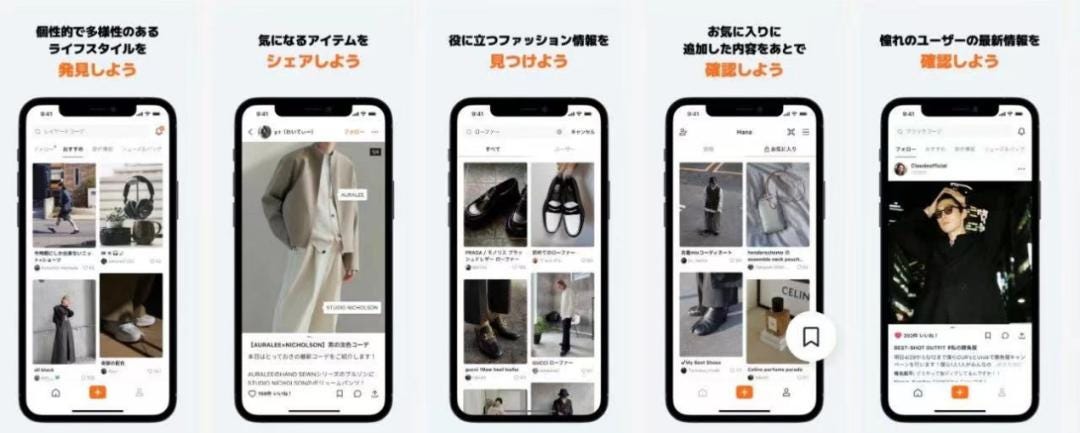
Xiaohongshu didn’t stop there. In October 2022, it launched Takib, a camping app built around Japan’s thriving outdoor culture. In March 2023, it followed up with habU, a beauty-focused platform. Both targeted categories where Xiaohongshu had deep expertise domestically. Both flopped. Downloads never moved beyond the double- or triple-digit range.
Southeast Asia
In April 2022, Xiaohongshu rolled out Spark across Southeast Asian markets including Singapore, Thailand, and Indonesia. Spark was the closest thing to a direct transplant of the domestic Xiaohongshu experience—the team copied the content framework wholesale, organizing feeds around fashion, beauty, travel, and urban living, and tried to build engagement through creator programs.
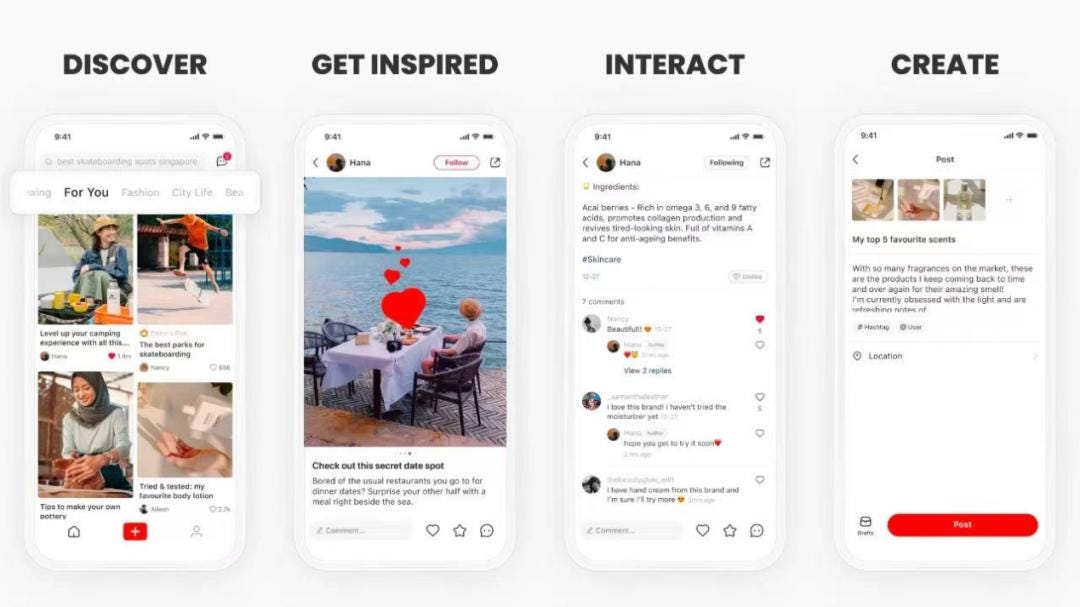
By December 2022, facing stagnant growth, Xiaohongshu repositioned Spark from a “product-sharing” platform to an “overseas shopping guide,” hoping to attract a smaller but higher-spending user base that could catalyze broader adoption. The strategy didn’t work. Growth continued to decelerate, and Spark was shut down in February 2023.
The U.S.
Xiaohongshu’s American ventures were even more fleeting. In late 2022, it launched Catalog, a home and lifestyle community app, in the U.S. market. The app went live in December and was dead by February—a lifespan of just two months. Xiaohongshu described the experiment as a “trial run,” promising a better successor would follow.
That successor, S’More, launched in mid-2023. Targeting New York City’s urban lifestyle scene—bars, performances, outdoor markets, City Walk routes—it aimed to help users discover and share local experiences. The concept sounded promising. The execution didn’t deliver. S’More never gained traction.
Then came January 2025, and an event no one at Xiaohongshu had planned for. When the U.S. Supreme Court upheld TikTok restrictions, a wave of American users—so-called “TikTok refugees”—flooded into Xiaohongshu’s main app. RedNote, its international version, surged to the top of the U.S. App Store, recording 3.84 million overseas downloads in a single week.
The spike didn’t sustain itself, but it left behind a residual user base that proved stickier than expected. By March 2025, RedNote’s U.S. daily active users had settled at around 800,000—a 114% jump over the prior December—while global overseas daily actives reached roughly 6.1 million.
That accidental momentum reshaped Xiaohongshu’s international playbook. In February 2026, the company spun out its global operations into a standalone division called “Rednote,” formally separating international from domestic for the first time.
With Redshop, Xiaohongshu is betting that a focused, niche-driven approach—handcrafted cultural goods, curated merchant selection, limited initial scale—can succeed where its earlier copy-paste strategies could not. The question is whether the lessons learned from six failures are finally enough.
Redshop enters the dance floor of Tik Tok. That needs huge investment to penetrate the market to compete in pricing.
Will Redshop make profit in the first 3 years?