


On July 30, 2025, U.S. President Trump signed an executive order eliminating the de minimis duty exemption for goods valued at $800 or less, effective August 29. While shipments from China had already lost this privilege as of May 2, industry watchers anticipated a major blow to direct-to-consumer giants like SHEIN and TEMU, which rely on small parcel exports.
However, the numbers tell a different story.
According to LatePost, SHEIN’s gross merchandise volume (GMV) reached $27 billion in the first half of this year, growing 15-20% year-over-year. TEMU, launched less than three years ago, saw its global GMV hit $35 billion during the same period, up 50%. Insiders say TEMU is targeting $100 billion in GMV for 2025, outpacing its mother firm Pinduoduo at a similar stage. SHEIN, which reported $52 billion in GMV last year, set its sights on slightly surpassing $60 billion this year.
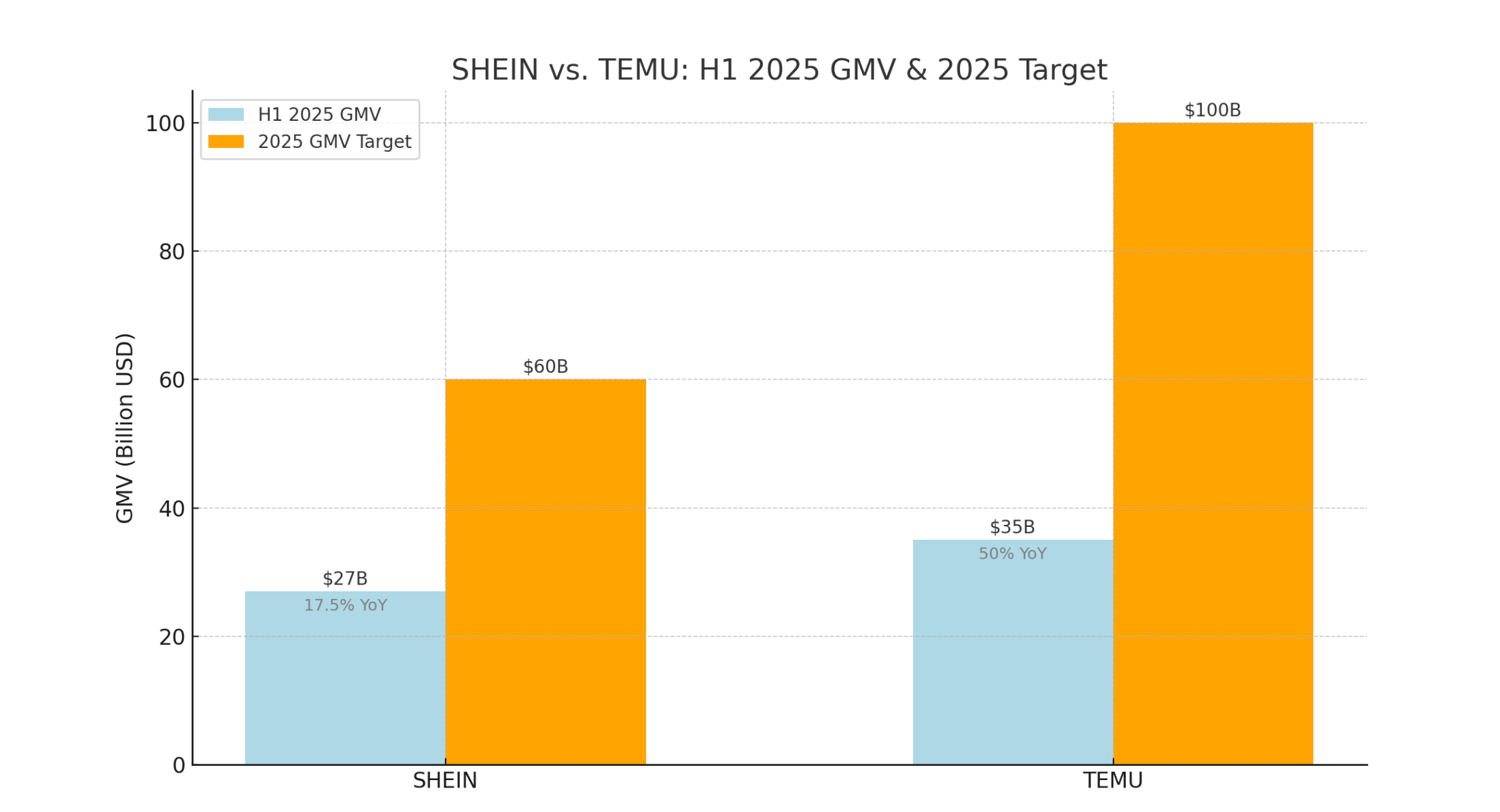
Surviving the Squeeze
Shein and Temu had a dry run for America’s new tariffs months before the policy officially hit. In February, the U.S. imposed a 10% tariff on Chinese goods and scrapped the $800 duty-free allowance for imports—a direct blow to cross-border sellers.
Both platforms responded by hiking prices, triggering an immediate drop in sales. Many products that couldn’t survive the new tariffs were delisted. Temu pulled numerous items shipped directly from China, instead steering users toward products shipped from U.S. warehouses—where sellers bear the cost of duties. Temu had already been nudging merchants toward this model since last year.
Some products saw prices jump more than 300%. According to Bloomberg Second Measure, sales at Shein and Temu fell 23% and 17% year-on-year, respectively, in the week following the hikes.
Within days, both platforms rolled back price increases and began labeling “Import Charges” more clearly, pointing to U.S. policy as the driver. One Temu user posted online that he paid $135.22 in fees for an $85.70 order.
By June, Temu was restoring direct shipping from China. During the interim, it tested a “Y2” semi-managed logistics option, allowing sellers to ship by air from any country, with fulfillment times extended to 6–14 days. For now, this is mainly used for new product launches.
Today, Chinese shipments to the U.S. clear customs via two channels: simplified (T11) for goods under $2,500, and standard (T01). Both are automated, with the main delays coming from queuing, not customs processing.
For T01, strict documentation and accurate value declarations are required, but for large shipments, per-item costs are minimal. Another insider points out that direct mail is taxed at retail, while inventory sent to overseas warehouses is taxed at wholesale.
In the end, logistics costs barely budged. A former Shein executive says that with a 60-day product lifecycle, modest price adjustments to cover shipping go largely unnoticed by consumers.
Going Global
With tariff tensions easing, Temu and Shein have paused price hikes. But their continued growth is powered by structural changes, not just policy relief.
Both platforms are looking beyond the U.S. for expansion. Temu’s semi-managed model is now available in Southeast Asia, Europe, the Middle East, and South America, while Shein has rolled out similar options in the Middle East. The U.S. now accounts for less than 30% of Shein’s global GMV and about 35% for Temu. According to a Shein executive, even if U.S. sales drop 20% due to tariffs, the global impact is only about 6%.
Shein’s own brands still delivers 70% of its GMV. Since 2020, it has allowed third-party merchants to open shops, selecting and pricing their own products, while handling overseas fulfillment. This year, Shein is ramping up support for third-party sellers with major traffic initiatives across key global markets.
In April, Shein explored converting some partner factories to a semi-managed model to improve inventory, ease cash flow, and absorb tariff costs, but shelved the plan as tariffs relaxed.
Temu introduced its semi-managed approach in March last year, looking for local sellers who could handle inventory and order fulfillment.
LatePost has learned that, by late July, Temu restructured its management team. Of about 20 secondary managers, eight now oversee category operations—including both full and semi-managed cross-border business for Chinese sellers. The rest have been assigned to international markets, where they focus on recruiting local semi-managed sellers and managing logistics.
Building up local merchant bases is easier in the U.S., where existing Amazon sellers are plentiful. In contrast, Europe’s market is fragmented, and Latin America’s e-commerce scene is dominated by regional giants, making local recruitment a challenge.